Fake leads on Meta ads are not random. They are a direct outcome of loose targeting, weak filters, and misaligned signals.
When lead quality drops, most advertisers immediately blame the platform. Meta becomes the easy target.
But Meta does not create fake leads. It only amplifies the signals it receives.
If those signals are unclear, inconsistent, or too broad, the system naturally optimizes for volume instead of relevance.
This is where the real problem begins.
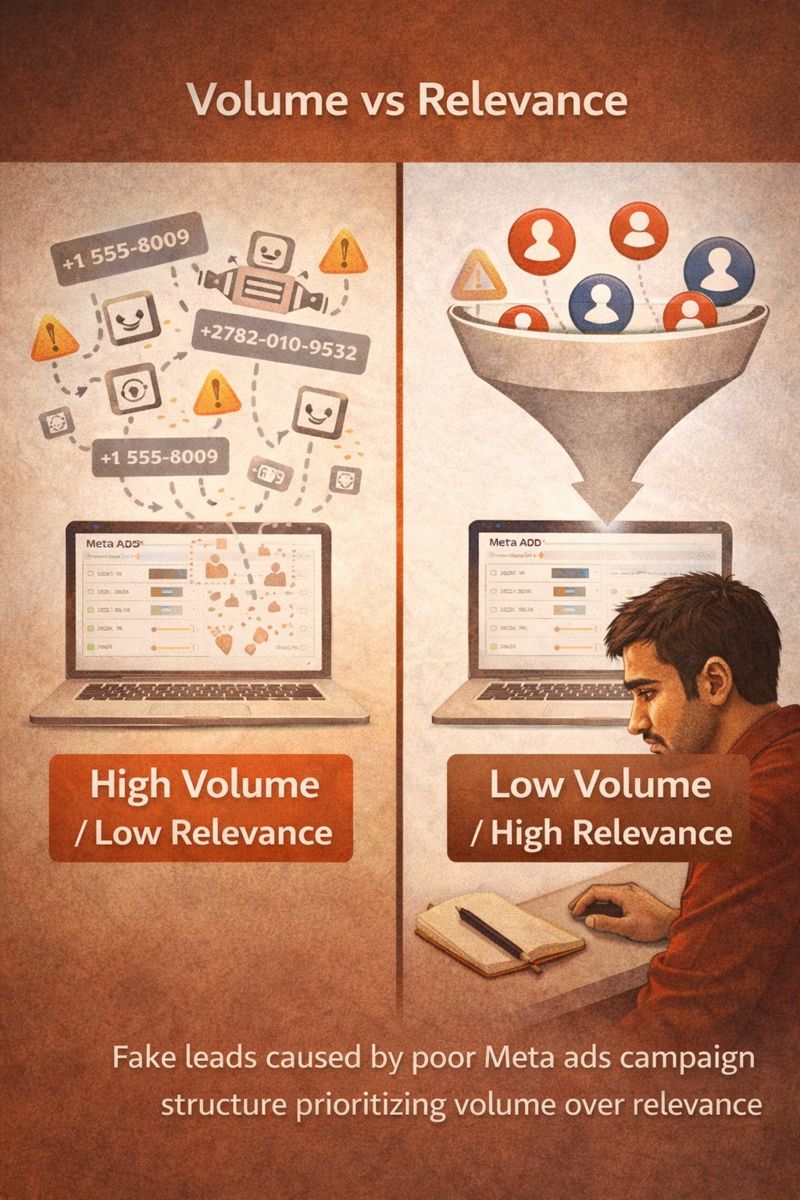
Fake Leads are a Signal of Poor Campaign Structure
Meta ads operate on pattern recognition.
The algorithm does not understand “good” or “bad” leads. It understands responses.
When campaigns are set up without strong constraints, the system prioritizes:
- Cheap clicks
- Easy form submissions
- Low-effort actions
Not because they are valuable, but because they are easy to generate at scale.
This is how irrelevant and fake leads enter the funnel.
"Fake leads are not random. They appear when campaigns prioritize volume over relevance."
A Common Real-World Scenario in Local Campaigns
Consider a local academy campaign targeting Tamil Nadu.
On the surface, everything looks correct:
- The location is selected
- The budget is controlled
- The ads are active
But soon, most leads start coming from North India. Many of them do not even understand Tamil.
Despite selecting Tamil Nadu as the target location, the campaign uses:
- “People living in or recently in this location”
- Advantage+ audience expansion
- English ad copy with instant lead forms
The outcome is predictable:
- Lead volume increases
- Lead relevance drops
- Sales teams waste time on follow-ups that go nowhere
This situation is not an exception. It is a repeat pattern in local lead generation campaigns.
Location Targeting Is Not as Precise as Assumed
Many advertisers assume location targeting is strict. In reality, it is flexible unless controlled properly.
When “People living in or recently in this location” is selected, ads may reach:
- Travelers
- Temporary visitors
- Users who recently passed through the area
For awareness campaigns, this may be acceptable. For lead generation, it is damaging.
For location-dependent businesses, relevance starts breaking before the click even happens.

Audience Expansion Reduces Control in Local Campaigns
Advantage+ audience expansion is designed to increase reach.
Reach, however, is not the same as relevance.
In local campaigns, audience expansion often leads to:
- Delivery outside the selected region
- Optimization for low-cost leads
- Loss of geographic intent
As reach increases, control decreases.
“More impressions do not mean better leads. They only mean more activity.”
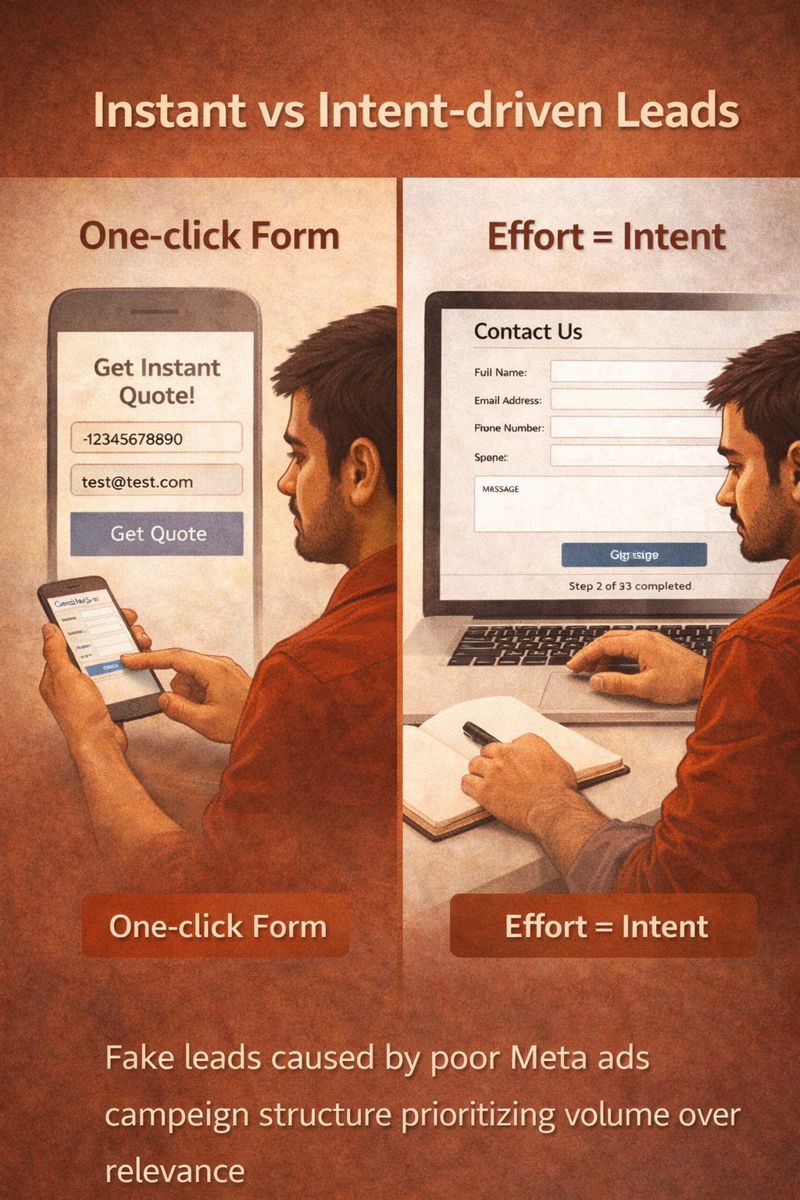
Easy Lead Forms Invite Low-Intent Users
“The simpler the form, the lower the commitment.”
Instant lead forms encourage:
- Casual submissions
- Test entries
- Fake phone numbers
Users can submit a form without thinking. Without reading. Without intent.
That is why high lead volume often hides poor lead quality.
Language Works as a Behavioral Filter
Language is not just a communication choice. It is a qualification layer.
When ads are created in a universal language:
- Clicks increase
- Reach expands
- Relevance drops
When ads are created in a local language:
- Irrelevant users self-filter
- Engagement becomes intentional
- Lead quality improves
“Using a local language often filters better than interest targeting alone.”
How to Reduce Fake Leads on Meta Ads
Fake leads cannot be eliminated completely. But they can be controlled.
The solution is not aggressive scaling. The solution is tightening the structure.

Turn Off Audience Expansion for Local Campaigns
Audience expansion trades control for reach. For local campaigns, control matters more.
Disabling expansion helps:
- Keep delivery within the selected region
- Improve lead relevance
- Make sales follow-ups meaningful
Add One Qualifying Question in the Lead Form
Adding a simple question such as:
“Which district are you from?”
creates friction. That friction:
- Filters casual users
- Improves lead relevance
- Saves hours of wasted follow-up
“Small barriers often improve results.”
Prefer Website Forms for High-Intent Leads
Website forms require effort.
Users must:
- Visit the website
- Read the content
- Take action deliberately
That effort is a signal.
Users who complete website forms are generally more serious than instant form fillers.

Choose Placements Manually
“Automatic placements optimize for volume. Manual placements optimize for behavior quality.”
Manual selection allows:
- Better control over engagement
- More predictable results
- Consistent lead relevance
For many local campaigns, Facebook Feed and Instagram Feed outperform other placements.
Fake Leads Will Always Exist — Control Is the Objective
No advertising platform delivers perfect leads.
The goal is not elimination. The goal is reduction and control.
- Fewer real leads outperform large volumes of fake ones
- Clean structure beats aggressive scaling
- Quality always beats numbers
Final Thought
Fake leads are not a platform failure. They are a signal of weak constraints.
When targeting, language, forms, and placements are aligned, Meta ads stop chasing volume and start delivering relevance.
“Lead quality improves when the system is guided with clarity.”