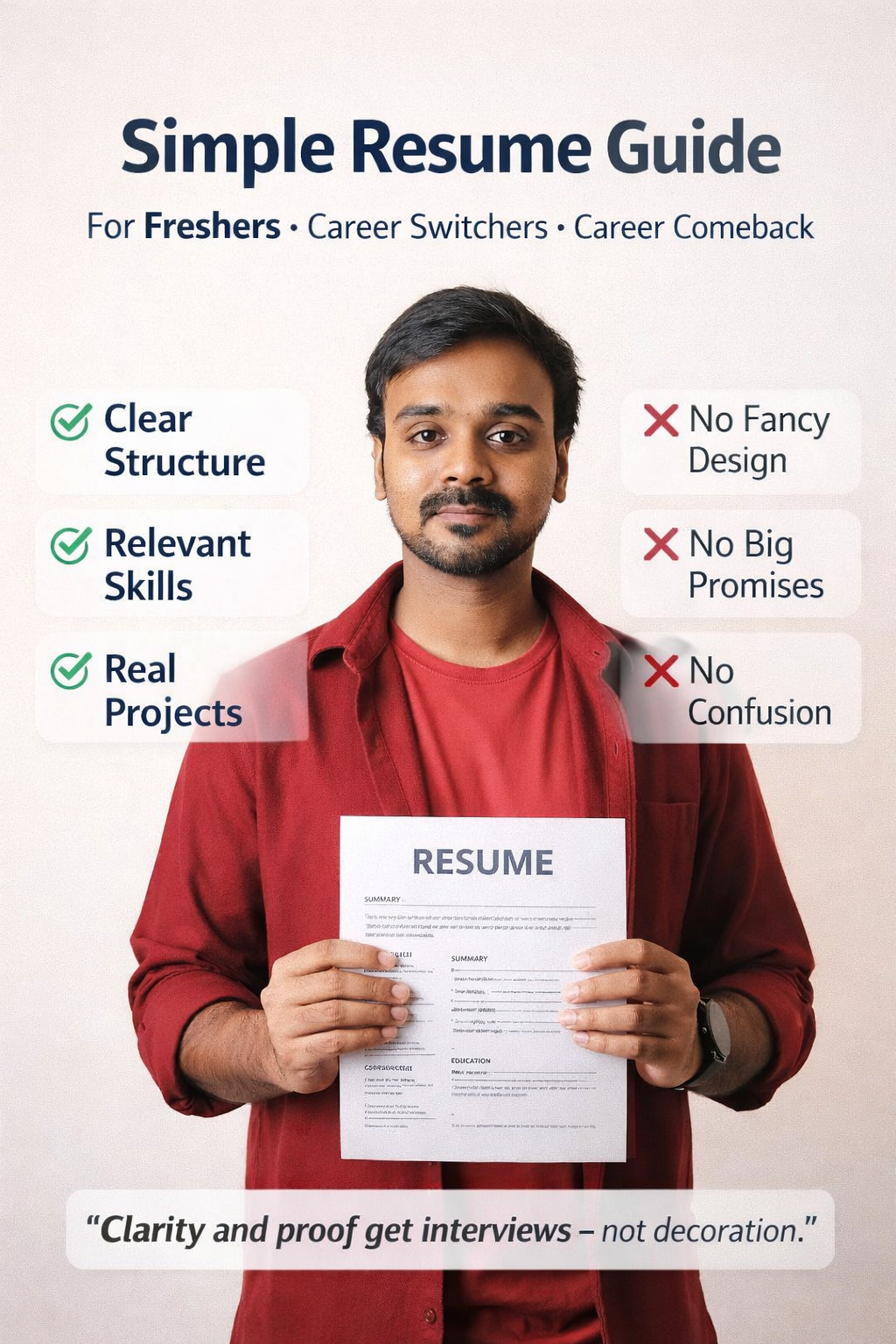
If you are reading this, you are probably:
- A college fresher
- Someone changing career
- A housewife planning to restart your career
First, relax.
You do not need a “perfect” resume.
You need a clear and simple one.
Let’s break this down in the easiest way possible.
First Understand Which Category You Belong To
Ask yourself:
Just completed college? → You are a Fresher
Worked before but changing field? → Career Switcher
Took a career break and restarting now? → Career Comeback
Now read only your section below.
1. If You Are a College Fresher
You don’t have job experience.
That is completely okay.
Your resume should show:
- What you learned?
- What you practiced?
- That you are ready to work
Your Resume Should Have Only These 6 Sections:
1. Contact Details
- Full Name
- Phone Number
- LinkedIn (if available)
Keep it simple.
2. Short Career Objective (2–3 lines only)
Write:
- Who you are?
- What role you are looking for?
- That you are eager to learn
Keep it short. No long paragraphs.
3. Skills
Just list what you know.
You can divide like this:
- Technical Skills
- Software / Tools
- Soft Skills (communication, teamwork, etc.)
Only mention skills you actually know.
4. Projects (Very Important)
If you don’t have experience, projects are your proof.
For each project, write:
- Project name
- What it was about?
- What you did?
- What you learned?
Simple. Clear.
5. Education
- Degree
- College name
- Year
- Percentage / CGPA
No need for long details.
6. Training / Internship (If Any)
If you completed any course or internship, write:
- Course Name
- Duration
- What you learned?
- Practical work done
Even small internships matter.
“Your resume must prove readiness through skills and projects — not promises.”
2. If You Are Changing Your Career
Maybe you worked in one field and now want to move into another.
Your resume must clearly explain:
Why you are changing?
What new skills you learned?
Why you are ready now?
Your Resume Should Include:
1. Contact Details
Same as above.
2. Short Professional Summary
Write:
- Your previous job background
- That you are shifting to a new field
- The training or skills you gained
- That you are serious about this transition
Be confident. Don’t sound confused.
3. Skills
Mention:
- New skills you learned
- Skills from your old job that are still useful (like communication, leadership, problem solving)
- Tools / Software Knowledge
Your past job is not useless. It adds maturity.
4. Previous Job Experience
Keep it short:
- Job title
- Company name
- Duration
- 3–4 main responsibilities
Only mention points that show transferable value.
5. New Course / Training
Write clearly:
- Course Name
- Duration
- Practical exposure
- Tools learned
- Projects completed
This shows you are serious about switching.
6. Projects in New Field
Even practice projects matter.
Write:
- Project name
- What you did?
- Skills used
- Outcome
“If you don’t clearly position your transition, recruiters will assume confusion. ”
If You Are a Housewife Restarting Career
First, remember this:
A career break is not a weakness.
Many companies respect people who restart confidently.
Your resume should show:
- You are updated
- You learned new skills
- You are ready to work
Your Resume Should Include:
1. Contact Details
Same as above.
2. Short Profile Summary
Write:
- Your previous background (if any)
- That you took a career break
- The new skills or training you completed
- That you are ready to restart your career
Keep a positive tone.
3. Skills
Mention only current and relevant skills.
Divide into:
- Soft skills
- Tools / Software Knowledge
Keep it honest and simple.
4. Recent Training
Write:
- Course Name
- Duration
- Practical exposure
- Tools learned
- Assignments or projects completed
This shows you are updated.
5. Projects After Career Break
Even small projects count.
Write:
- Project name
- What you worked on?
- What you learned?
- Skills applied
Action builds confidence.
6. Previous Experience (If Any)
If you worked before your break, mention briefly:
- Job title
- Company
- Duration
- Main responsibilities
“Confidence plus updated skills matters more than the career gap. ”
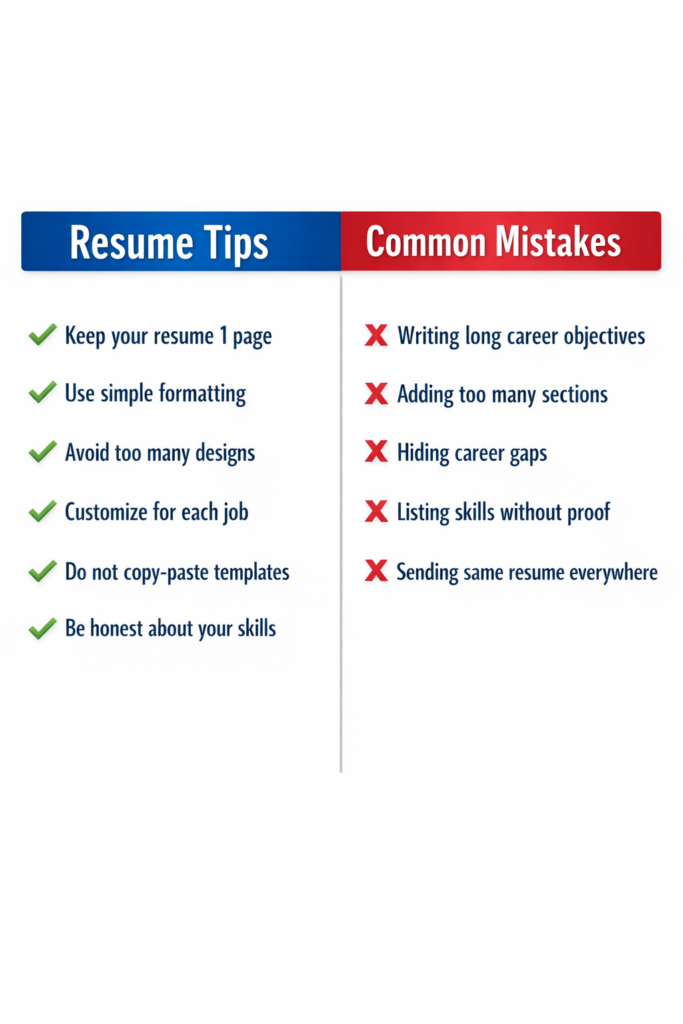
Final Simple Truth
Your resume is not about how much you know.
It is about how clearly you present what you know.
You don’t need:
- Big experience
- Fancy design
- Complicated sections
You only need:
- Clear structure
- Relevant skills
- Proof through projects
- Confidence
“Clarity and proof get interviews — not decoration. ”