If your Meta ads are generating bad leads, low-quality inquiries, or no meaningful results, you’re not alone.
This is one of the most common problems advertisers face — especially with lead form campaigns.
And no, it doesn’t automatically mean your ads are “bad” or that Meta ads don’t work.
In most cases, the issue comes down to wrong signals, weak intent filtering, and incorrect optimization logic.
Let’s break this down clearly — without hype, without jargon.
Why Do Meta Ads Generate Poor-Quality Leads?
"Meta’s algorithm works on signals, not assumptions. "
If the system doesn’t understand:
- who converts,
- who becomes a real customer,
- who is just clicking for fun
it will optimize for the easiest possible outcome — cheap leads, not qualified leads.
That’s where most advertisers get stuck.
1. No Meta Pixel = No Learning = Random Leads
If you haven’t installed the Meta Pixel, here’s what Meta does not know about your business:
- Who is a good lead
- Who is a bad lead
- Who actually engages beyond the form
- Who converts into a customer
Without Pixel data, Meta has zero feedback loop.
So what does it do?
It targets users who are most likely to submit forms easily, not users who are likely to buy.
That’s why you see:
- Low-cost leads
- Poor-quality inquiries
- People who don’t remember filling the form
Even for a new website or business, Pixel installation is non-negotiable.
“ The learning is slow at first, but quality improves only when Meta starts understanding outcomes. ”
2. Detailed Targeting Isn’t Saving You Anymore
Many advertisers try to “fix” bad leads by stacking interests.
Meta no longer relies heavily on detailed targeting — especially with small to medium budgets.
Even if you select:
- 15–20 relevant interests
- Job titles
- Behaviors
Meta often expands beyond them.
Why?
Because Meta optimizes based on delivery efficiency, not interest accuracy.
So when leads are bad:
- it’s not because you chose the wrong interest
- it’s because the system lacks conversion-quality signals
“Targeting alone cannot correct poor optimization data. ”
3. Your Lead Form Is Too Easy — And That’s a Problem
If your Instant Form only asks for:
- Name
- Phone number
you’re inviting low-intent behavior.
This results in:
- Accidental submissions
- Curiosity clicks
- Users with zero buying intent
- Leads who ghost immediately
Meta sees these as “successful leads” and keeps pushing your ads to similar low-effort users.
“The easier the form, the cheaper the lead — and the lower the quality. ”
This is why form structure directly affects algorithm learning, not just user quality.
4. Can the Wrong Campaign Objective Cause Bad Leads on Meta Ads?
If you’re using:
- Leads objective
- With Instant Forms
Meta’s goal becomes simple:
Get as many leads as possible at the lowest cost.
Not:
- Qualified leads
- Sales-ready users
- High-intent prospects
Meta does exactly what you ask it to do.
If you optimize only for “leads”, Meta does not evaluate:
- Intent
- Seriousness
- Purchase readiness
This is why lead volume goes up while business results stay flat.
5. Why Someone Else Gets Better Results With the Same Ad
This comparison is extremely misleading.
Even if:
- The video is the same
- The business category is the same
- The location is the same
their account history is not.
They may have:
- Older ad account
- Stronger page trust
- Historical Pixel data
- Prior conversions
- Warm audiences
- Higher engagement
- Better optimization signals
Meta rewards accounts with proven outcomes.
“A new or low-data account will always struggle initially — that’s normal, not failure. ”
The Real Issue: Meta Doesn’t Know What “Quality” Means Yet
Bad leads are rarely caused by:
- Ad creatives alone
- Targeting alone
- Platform issues
They are caused by poor feedback signals.
Until Meta understands:
- Which leads convert
- Which leads matter to your business
it will continue optimizing for the wrong users.
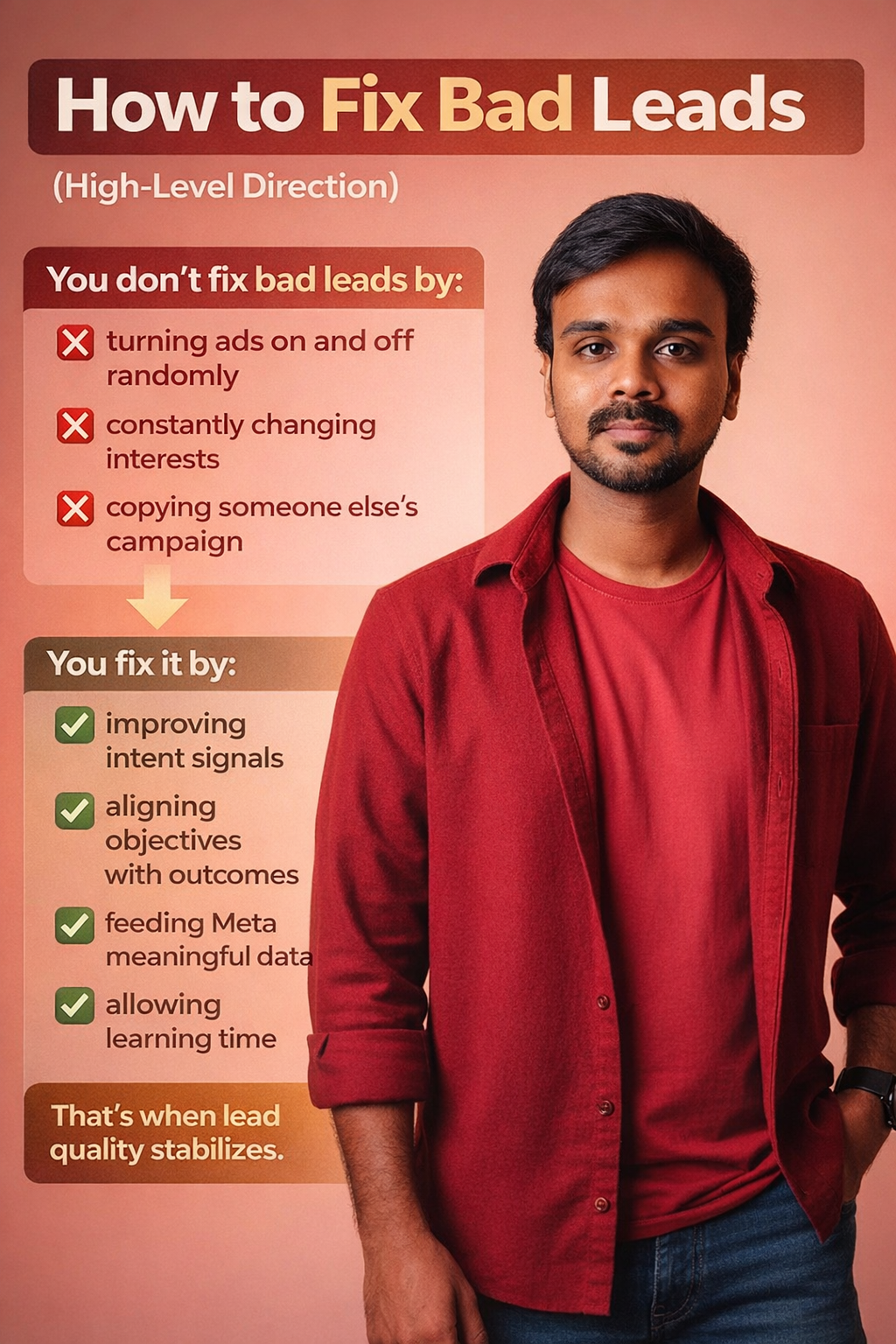
Why Meta Ads Give Bad Leads?
Meta ads usually generate bad leads because:
- The Meta Pixel is missing or under-trained
- Campaigns are optimized for lead volume, not intent
- Instant lead forms are too frictionless
- The algorithm lacks quality feedback signals
Final Thought
Meta ads usually fail because the system is optimizing with poor signals, not because the platform doesn’t work.
When Meta doesn’t understand who a quality lead is, it defaults to cheap and easy conversions.
“Fix the signals, align the objective, and give the system time to learn — lead quality improves naturally. ”